


Material Science at the Core: Engineering PFAS Destruction for Industrial Scale
Demonstrating PFAS degradation under controlled laboratory conditions is one challenge. Translating that performance into an industrial system that operates reliably across complex water matrices, at acceptable energy consumption, electrode lifetime and system cost, is another.
For industrial site operators, environmental managers and process engineers evaluating PFAS destruction technologies, this ultimately comes down to two questions: Can PFAS destruction be achieved reliably under real-world operating conditions? And can the process be engineered at a cost that enables commercial deployment?
At PFASuiki, these questions shape two closely connected areas of R&D. The first is electrode material development: engineering material systems with the performance, durability and cost structure required for industrial scale-up. The second is process engineering: systematically testing how water chemistry, current density, flow conditions and other operating parameters influence degradation performance, energy consumption and byproduct formation.Together, these workstreams address both sides of the economics of electrochemical PFAS destruction.
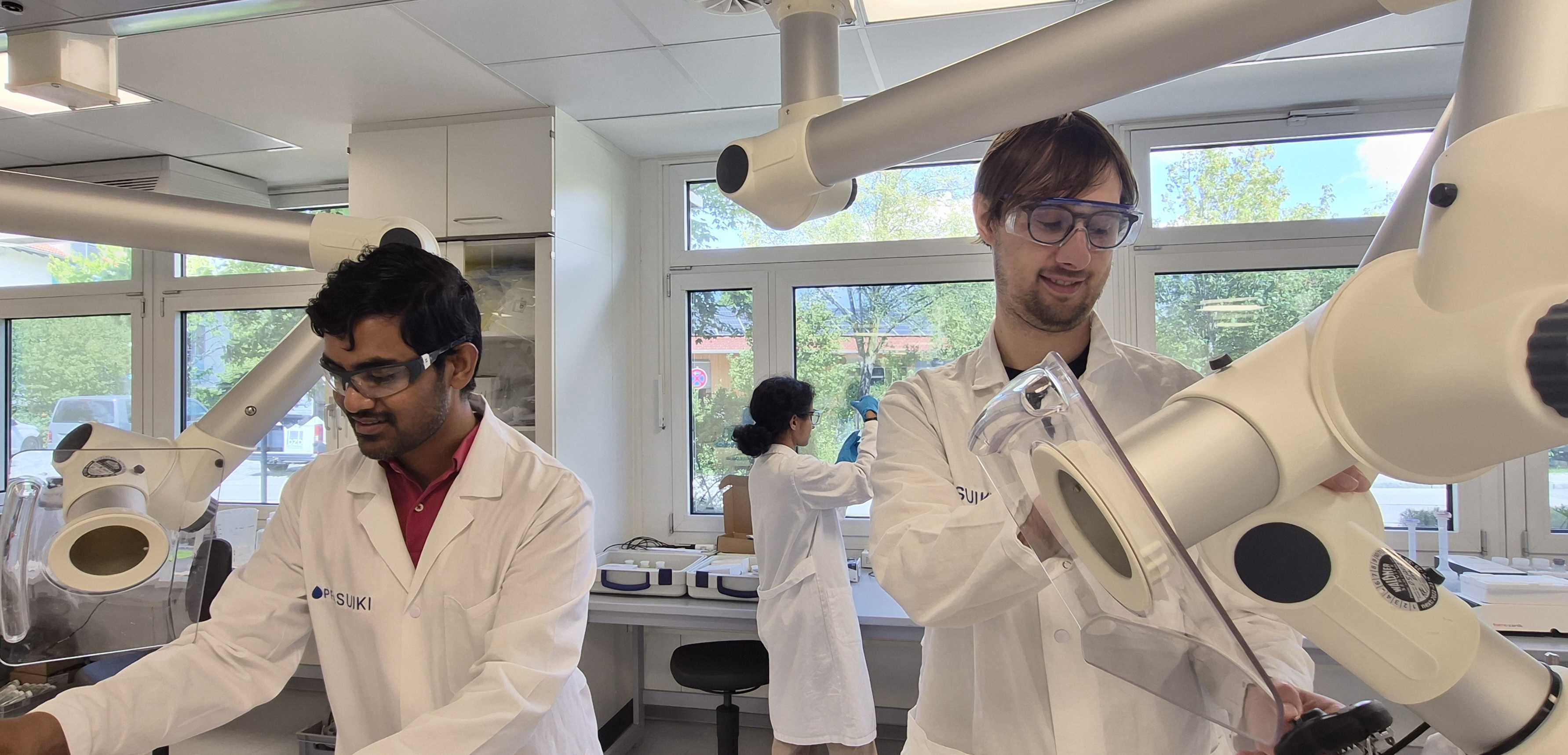
We spoke with three members of our R&D team working across these challenges: Matteo, Senior Engineer – Electrochemistry and Materials; Reeja, Junior R&D Engineer – Water Treatment; and Sravan, Senior R&D Engineer – Material Development.
1. At the Core of the Reactor: Electrode Material Development
In electrochemical oxidation (ECO), the electrode is one of the defining components of the reactor. Its properties influence reaction pathways, PFAS degradation performance, electrode lifetime and ultimately the economics of the system.
Boron-Doped Diamond (BDD) is widely used as a benchmark electrode material for advanced electrochemical oxidation because of desirable properties including its wide electrochemical potential stability window, high oxygen evolution overpotential, chemical stability and the ability to generate reactive hydroxyl radicals (•OH).
These characteristics make BDD attractive for the oxidation of highly persistent organic compounds. But effectiveness alone does not determine whether an electrode technology can be deployed economically at industrial scale.
Material cost, substrate selection & availability, manufacturing processes, active surface area, durability and replacement intervals all contribute to the total cost of an electrochemical system.
For PFASuiki, material development therefore addresses a fundamental scale-up question: Can we engineer electrode materials that maintain the electrochemical performance required for PFAS destruction while improving the cost structure and manufacturability of the system?
“Material development is the foundation of our electrochemical system. By choosing and engineering the right material, you directly influence performance—both in terms of PFAS destruction efficiency & byproduct generation, and the long-term working life of electrodes. We are working on material chemistries specifically designed to be more cost-efficient than the current status quo, with industrial scale-up in mind.”
— Matteo, Senior Engineer – Electrochemistry and Materials
This means looking beyond a single electrode material. Different material compositions, substrates and surface properties can influence electrochemical activity as well as stability under demanding operating conditions.
For Sravan, this continuous material development is an essential part of building a deep-tech platform:
“In deep tech, the material platform cannot remain static. What performs well at laboratory scale still has to meet requirements for manufacturability, lifetime, reproducibility and cost at industrial scale. That is why material development continues in parallel with reactor development—we are not optimizing only for today's performance, but for the system we ultimately want to manufacture and deploy.”
— Sravan, Senior R&D Engineer – Material Development
The objective is therefore not simply to identify an electrode that can degrade PFAS. It is to develop a material platform that combines electrochemical activity, durability, scalability and cost efficiency.
2. From Material Performance to the Operating Window
Electrode development is only one side of the equation.
An electrode that performs well under defined laboratory conditions must ultimately operate consistently well in real water streams containing a complex mixture of inorganic ions, dissolved organic matter and other constituents that can interact with the electrochemical process or even passivize the catalyst.
This is where process development and real-water testing become critical.
Using different experimental reactor configurations, the R&D team systematically varies operating parameters such as current density, voltage, geometry, flow rate and treatment time while observing how the system responds to different water matrices.
The goal is not simply to maximize the amount of electrical energy supplied to the reactor. It is to identify the operating window in which the energy is used most effectively.
Higher current density, for example, does not necessarily translate into proportionally higher PFAS degradation. In complex matrices, competing electrochemical reactions can consume energy, while naturally occurring constituents may promote unwanted reaction pathways. More aggressive operating conditions can also affect electrode lifetime.
The engineering challenge is therefore to understand the interaction between three dimensions: the electrode material, the operating conditions and the composition of the water being treated.
“When a sample comes in, we run the reactor under different operating conditions to identify the stream specific operating window that works most efficiently for that particular matrix. Higher current doesn't automatically mean better degradation. Other components in the water can participate in electrochemical reactions as well, which affects both energy efficiency and byproduct formation.”
“Fine-tuning the process helps us understand where we can reduce electricity consumption while maintaining degradation performance and controlling unwanted reaction pathways.”
— Reeja, Junior R&D Engineer – Water Treatment
Engineering the Operating Window for PFAS Destruction
Material properties, process conditions and water chemistry jointly determine electrochemical performance and system economics.
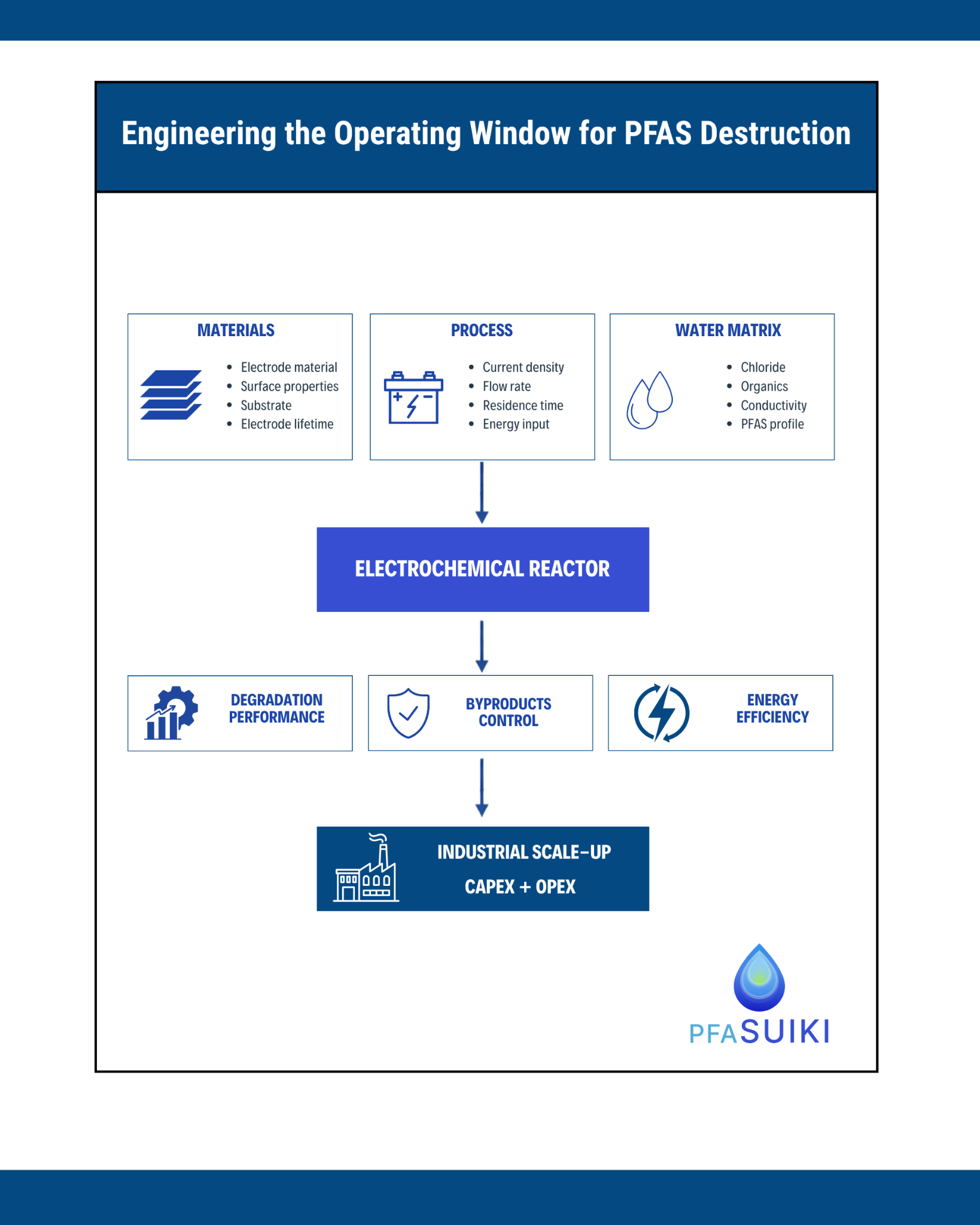
Figure: Electrochemical PFAS destruction is not governed by a single parameter. Material properties, reactor operating conditions and the composition of the water matrix interact to determine degradation performance, energy demand, byproduct formation and electrode lifetime. Mapping these relationships is central to defining an efficient operating window for industrial applications.
3. Real Water Changes the Electrochemistry
The graphic illustrates why moving from synthetic laboratory matrices to real industrial samples represents such an important step in technology development.
Industrial wastewater is rarely chemically simple.
Chloride, sulfate, dissolved organic carbon, fluoride and other constituents can all influence electrochemical reactions. Their concentrations can vary substantially between applications-and sometimes even between samples from the same site.
For electrochemical PFAS destruction, understanding these interactions is essential.
One important example is chloride. Under certain electrochemical conditions, chloride-containing waters can promote the formation of chlorine oxyanions such as chlorate and perchlorate. Other organohalogen compounds may also form depending on the matrix and operating conditions.
The task for the R&D team is therefore not simply to measure how quickly PFAS concentrations decrease. It is to understand what else is happening inside the reactor at the same time.
This is why real-sample testing forms an important feedback loop in process development:
Water matrix → Operating conditions → Electrochemical reactions → PFAS degradation & byproduct formation → Process adjustment
The resulting data informs decisions about current density, flow conditions, treatment time, electrode configuration and when pre- and post-treatment is necessary.
Over time, this builds a deeper understanding of how the reactor should be operated across different industrial matrices.
4. Pre- and Post-Treatment: Engineering the Complete Process
Not every water matrix should enter an electrochemical reactor unchanged.
Depending on the matrix composition, pretreatment can help create more favorable conditions for electrochemical destruction, while post-treatment can address specific residual constituents or byproducts.
For Reeja, this means looking beyond the electrochemical cell itself and considering the complete process around it.
The objective is to understand questions such as:
Which matrix constituents interfere with PFAS degradation? Which operating conditions minimize competing reactions? When does pretreatment improve overall efficiency? And where can post-treatment complement the electrochemical step?
This system's perspective becomes increasingly important as the technology moves from controlled experiments toward customer-specific applications.
Rather than defining one universal operating recipe, the team is building the knowledge required to adapt the process to different real matrices while maintaining a consistent engineering framework, allowing for more and more fine-tuning towards specific customer streams.
5. Concentrate First, Destroy Second: Engineering the Treatment Train
Process optimization does not stop at the reactor boundary.
Electrochemical destruction is particularly relevant for PFAS-rich, lower-volume streams. Applying an energy-intensive destruction process directly to very large volumes of dilute water can increase reactor size requirements and the specific energy demand of the process due to the nature of the destruction process.
For many applications, the more efficient architecture is therefore a treatment train: first separate and concentrate PFAS, then apply destruction to the resulting smaller-volume stream for a better overall utilization of energy in the treatment train.
This creates a natural interface between electrochemical destruction and established separation technologies.
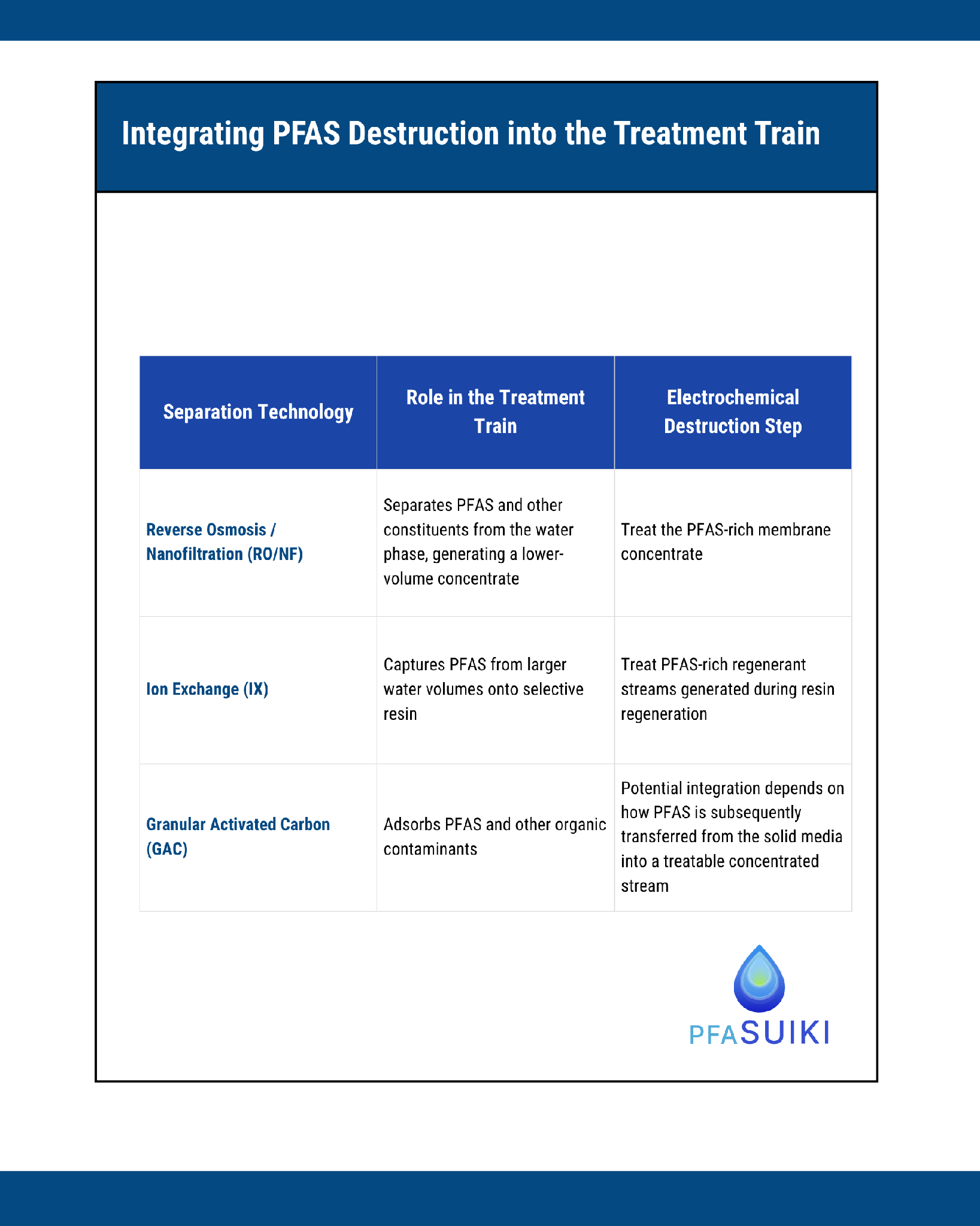
The principle is straightforward: use separation where separation is efficient, and destruction where destruction is most effective.
For PFASuiki, this also means working alongside providers of complementary water-treatment technologies rather than viewing every separation technology as a competing solution.
The electrochemical reactor can become the endpoint of the treatment train sequence - the step designed to address the concentrated PFAS stream generated upstream.
6. Material Development and Process Engineering Must Evolve Together
Materials and process parameters cannot be optimized independently.
Changing an electrode material can influence electrochemical activity, stability and thus the optimum current density. Changing the water matrix can alter competing reactions. Changing the operating conditions can affect electrode lifetime.
The development process is therefore iterative:
Material → Reactor conditions → Water matrix → Performance → Learning → Next material and process iteration
That requires parallel experimental programs and disciplined experimental design.
Reflecting on his background in inorganic functional materials-including work related to solar energy and hydrogen production through water splitting-Matteo sees this combination of material science and electrochemistry as central to the team's approach.
“In our lab, we deal with several types of tests and tasks at the same time. Working at PFASuiki requires being highly organized and disciplined in experimental planning. Because we operate in a fast-paced environment, the challenge is balancing speed with scientific rigor-generating the highest amount of learning from the shortest time and fewest experiments.”
“That takes intrinsic curiosity, but also close coordination across the team. The catalyst material, electrochemical process and the water matrix cannot be considered separately.”
— Matteo, Senior Engineer – Electrochemistry and Materials
This interaction between disciplines is what turns individual experiments into engineering knowledge.
7. From Electrochemistry to Industrial Economics
The transition from laboratory-scale PFAS degradation to industrial destruction is ultimately a multidimensional engineering problem.
The electrode material influences performance, lifetime and CAPEX.
The operating window influences energy consumption, degradation performance and OPEX.
The water matrix influences reaction pathways and byproduct formation.
And the surrounding treatment train determines how much water ultimately needs to pass through the destruction step in the first place.
Optimizing any one of these factors in isolation is not enough on its own to develop a best-in-class technology for PFAS destruction.
At PFASuiki, material development and process engineering therefore evolve together. By developing new electrode material systems, testing them under increasingly realistic conditions and systematically mapping the relationship between water chemistry and electrochemical performance, our R&D team is working toward a clear objective:
To translate electrochemical PFAS destruction from promising chemistry into a robust, scalable and economically viable industrial technology that will destroy PFAS reliably for years to come.