



For multinational industrial operators, chemical manufacturers, and supply chain managers, regulatory compliance historically meant adapting to local enforcement. Today, as forever chemicals take center stage in international environmental policy, a fundamental divergence between European and American legal frameworks creates an unprecedented operational challenge.
Both jurisdictions are accelerating their crackdowns on per- and polyfluoroalkyl substances, yet they rely on fundamentally different legal doctrines and chemical definitions. The result is a growing transatlantic gap that leaves global facilities caught in a complex compliance loop.
The EU Approach: Broad Hazard and Point-Source Control
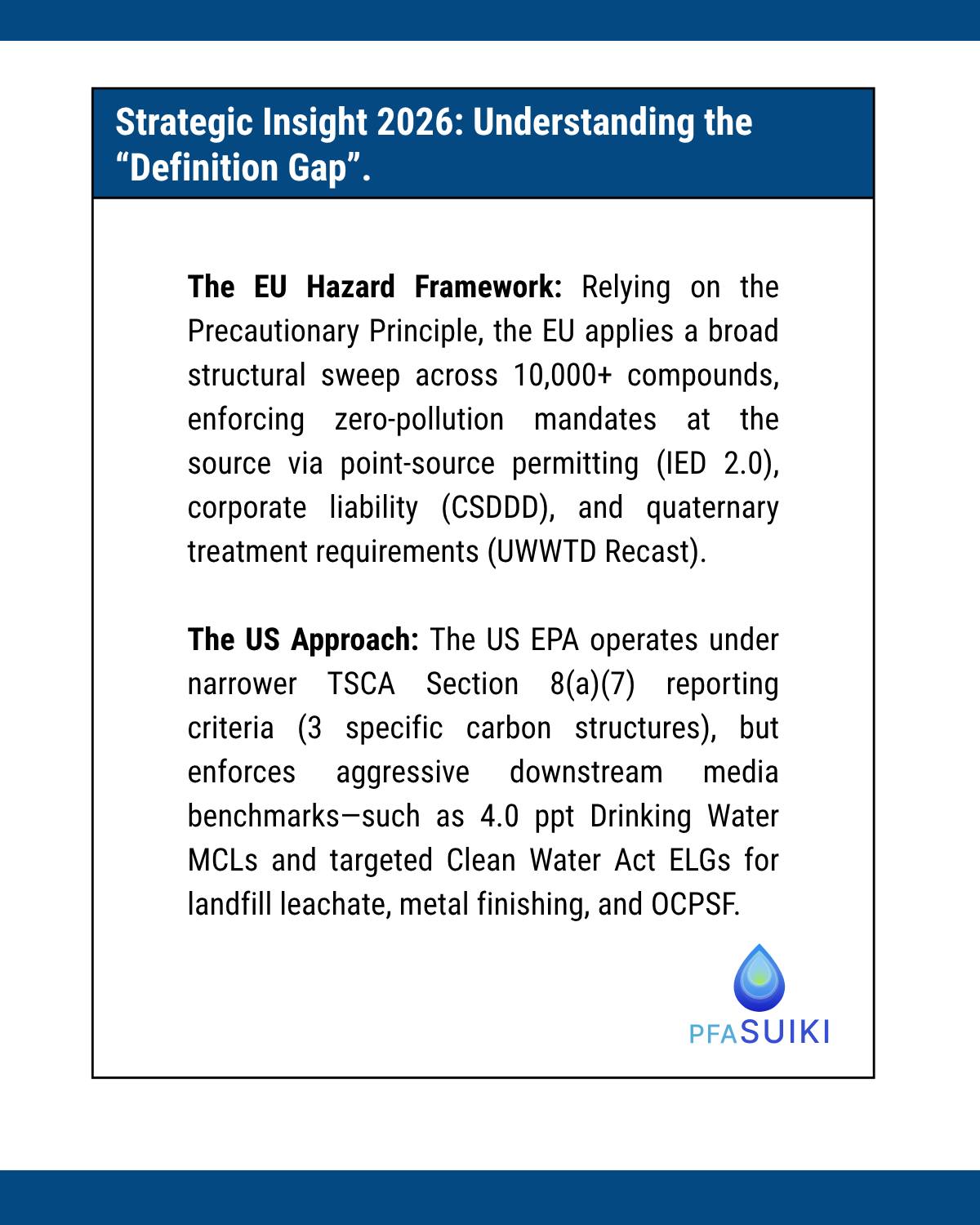
Within the European Union, PFAS policy relies on the Precautionary Principle and broad structural hazard definitions. The EU framework targets the entire chemical family, capturing over 10,000 compounds, based on the presence of at least one fully fluorinated methyl (-CF3) or methylene (-CF2-) carbon atom.
This structural sweep relies on an expanding matrix of point-source regulations:
- Stricter Permitting (IED 2.0): The recast Industrial Emissions Directive (Directive (EU) 2024/1785) enforces zero-pollution goals by tightening Best Available Techniques (BAT) emission limits at the facility level.
- Downstream Supply Chain Liability (CSDDD): Under the Corporate Sustainability Due Diligence Directive (Directive (EU) 2024/1760), parent companies face civil liability and fines if their global supply chains or waste handlers mishandle persistent pollutants.
- Municipal Discharge Mandates (UWWTD Recast): The recast Urban Wastewater Treatment Directive (Directive (EU) 2024/3019) mandates a quaternary treatment stage across European water infrastructure. This pushes industrial operators to manage persistent point-source discharges before they reach public sewers.
For facilities operating in Europe, compliance increasingly requires treating persistent compounds at the source.
The US Approach: Narrow Structural Criteria and Reporting
Across the Atlantic, the US Environmental Protection Agency (EPA) operates under a risk- and structure-based framework. Rather than applying a blanket family-wide sweep, US federal policy under TSCA Section 8(a)(7) restricts its reporting definition to three specific chemical structures: saturated carbon chains, ether linkages and branched saturated carbons.
This creates a significant regulatory blind spot. Many complex fluorinated molecules, such as specialized pharmaceuticals, agricultural intermediates, or fluorinated refrigerants, fall completely outside the US reporting window while triggering total chemical restrictions in Europe.
At the same time, the US applies aggressive downstream media enforcement:
- Enforceable Water Benchmarks: Under the National Primary Drinking Water Regulations, the US EPA set enforceable Maximum Contaminant Levels (MCLs) at 4.0 ppt for specific legacy compounds like PFOA and PFOS.
- Effluent Limitations Guidelines (ELGs): Under the Clean Water Act, the EPA continues to roll out targeted ELGs for specific industrial point-source categories, including Organic Chemicals, Plastics, and Synthetic Fibers (OCPSF), metal finishing, and landfill leachate.
The Compliance Loop: The "Definition Gap" and Supply Chain Paralysis
This conflict between the EU broad hazard sweep and the US EPA narrow 3-structure criteria creates an impossible compliance standard for multinational manufacturers.
A molecule manufactured or used in Michigan may be legally excluded from US TSCA reporting, yet be classified as a regulated forever chemical the moment it enters a supply chain in Munich. If a multinational firm relies on US definitions to push back against European restrictions, it faces severe supply chain paralysis when European regulators, guided by ECHA SEAC opinions, enforce strict product bans and civil liability under CSDDD.
Furthermore, relying on localized physical separation technologies, such as granular activated carbon or reverse osmosis, leaves operators exposed in both markets. Filtration lowers concentration numbers to meet a local discharge permit, but it generates a concentrated secondary waste stream (spent media or liquid retentate). As EU and US rules tighten around secondary waste disposal, shifting contaminants into sludge or filter media retains the underlying legal and financial liability.
.png)
Navigating the Divide: Achieving On-Site Destruction
Lobbying over chemical definitions is a temporary delay tactic. It does not protect balance sheets as global discharge standards continue to tighten.
To exit the transatlantic compliance loop, industrial risk management requires moving beyond simple filtration. At PFASuiki, we define the permanent hedge against divergent global regulations as Endpoint Sovereignty: verifiably destroying persistent compounds on-site at their point of concentration.
By integrating direct destruction technologies like electrochemical oxidation, facilities achieve total mineralization, converting persistent PFAS molecules into stable end-products such as carbon dioxide, water, and fluoride ions.
Whether responding to strict EU point-source destruction mandates or navigating narrowing US Effluent Limitations Guidelines, on-site mineralization eliminates secondary waste liabilities, bypasses definition debates entirely, and establishes a future-proof baseline for global compliance.

.png)